
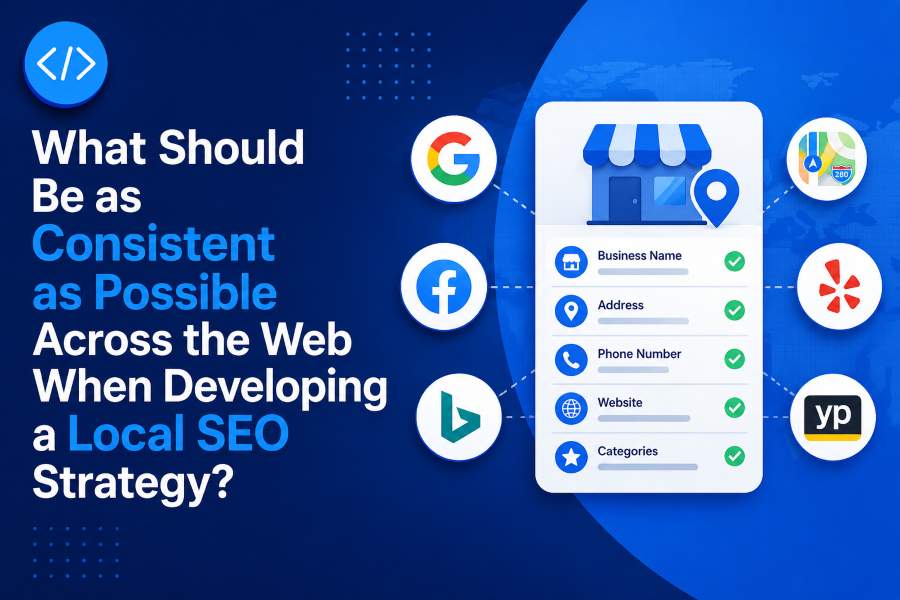
If you are building a local SEO strategy, one question matters more than many beginners realize: what should be as consistent as possible across the web when developing a local SEO strategy? The short answer is your business information, especially your name, address, and phone number. But the real answer goes a little deeper.
Local search depends heavily on trust. When Google, Bing, Apple Maps, Yelp, directories, social profiles, and business listings all show the same information about your company, search engines feel more confident that your business is real, active, and relevant to local customers. When those details conflict, your visibility can suffer.
For example, if your Google Business Profile says “Alvi Web Solutions,” your website says “With Alvi,” one directory lists an old phone number, and another shows a previous address, search engines and customers both receive mixed signals. That inconsistency can hurt local search rankings, reduce calls, and create a poor user experience.
This guide explains what needs to stay consistent across the web, why NAP consistency matters, how to audit your listings, and how to maintain clean local citations over time. If you are a local business owner, agency, freelancer, or service-area business, this is one of the most practical local SEO foundations you can fix.
Direct Answer Box
What should be as consistent as possible across the web when developing a local SEO strategy?
Your business name, address, and phone number, often called NAP, should be as consistent as possible across the web when developing a local SEO strategy. You should also keep your website URL, business hours, categories, services, descriptions, and service areas consistent across your website, Google Business Profile, directory listings, maps, and social profiles.
Why Consistency Matters in a Local SEO Strategy
Local SEO is built around relevance, distance, and prominence. Search engines want to show nearby businesses that match the searcher’s need and appear trustworthy. Consistent online business information supports that trust.
When your business details match across your website, Google Business Profile, Bing Places, Apple Business Connect, Yelp, Facebook Business Pages, LinkedIn Company Pages, and directory listings, search engines can connect those mentions to the same business entity. This helps reinforce your local presence.
Inconsistent information creates friction. Search engines may struggle to confirm which address is correct, which phone number customers should call, or whether two similar listings represent the same business. Customers may also lose confidence if they find different hours or contact details on different platforms.
This matters even more for local SEO for small business because smaller companies often rely on fewer trust signals. A larger brand may have thousands of mentions, reviews, and backlinks. A local service provider may depend on a smaller set of citations, reviews, and location signals. That makes citation consistency more important.
NAP consistency is not a magic ranking button, but it is a foundational local SEO best practice. It supports search engine confidence, helps avoid customer confusion, and improves the quality of your local business SEO footprint.
If your website is also part of a broader digital growth plan, your local SEO should connect with your site structure, service pages, and content strategy. You can explore more growth-focused support through With Alvi’s services.
What Business Information Should Stay Consistent Across the Web?
Your NAP is the core, but it is not the only thing that matters. Local SEO citations work best when all major business details are accurate, complete, and aligned.
1. Business Name
Your business name should match your real-world branding. Avoid adding extra keywords unless they are part of your legal or public business name.
Good example:
“Bright Path Dental”
Risky example:
“Bright Path Dental Best Dentist in Austin”
Keyword stuffing your business name can violate platform guidelines and create inconsistency across listings. Use the same business name on your website, Google Business Profile, local citations, directory listings, and social profiles.
2. Address
Your address should follow the same format wherever possible. Small formatting differences like “Street” vs. “St.” are usually not disastrous, but outdated or conflicting addresses are a serious issue.
If you moved locations, update every major listing. If you are a service-area business and do not serve customers at your physical address, make sure your Google Business Profile and other listings are set up correctly.
3. Phone Number
Use one primary local phone number if possible. A local number can feel more trustworthy to nearby customers than a generic call center number.
If you use call tracking, configure it carefully so it does not create inconsistent citations across the web. Your main business phone number should remain stable in major directories.
4. Website URL
Your website URL should be consistent and canonical. For example, do not use all of these randomly across listings:
https://example.comhttp://example.comhttps://www.example.comhttps://example.com/home
Choose the preferred version and use it across your listings. This helps search engines connect your citations to the right website.
5. Business Hours
Business hours should match across Google Business Profile, Bing Places, Apple Business Connect, Yelp, Facebook, and your website.
Wrong hours can cost real leads. If someone visits your shop or calls after seeing incorrect hours, that creates frustration and may lead to negative reviews.
6. Categories and Services
Your business categories should be aligned across platforms. If you are a web design agency, digital marketing consultant, plumber, law firm, dentist, or restaurant, choose the closest category available on each platform.
Services should also match. For example, if your website says you offer emergency plumbing but your directory listings only mention general plumbing, you may miss relevant searches.
7. Business Description
Your descriptions do not need to be identical word for word, but they should communicate the same core message. Keep your services, location, audience, and value proposition aligned.
For more on how search and website structure connect, read this guide on SEO in web design and development.
Step-by-Step Process to Audit Local SEO Consistency
A local SEO audit does not need to be complicated. The goal is to find inconsistent business information, fix it, and create a system so the same issues do not return.
Step 1: Create Your Master Business Profile
Start with one source of truth. This should include:
- Official business name
- Full address
- Main phone number
- Website URL
- Business hours
- Business categories
- Service areas
- Short business description
- Long business description
- Social profile URLs
- Logo and brand assets
Save this in a document your team can access. Every future listing should follow this master profile.
Step 2: Check Your Website First
Your website should be the clearest source of your business identity. Check your homepage, contact page, footer, location pages, schema markup, and service pages.
Make sure your name address phone information is visible and consistent. If your footer has one phone number and your contact page has another, fix that before updating external listings.
You can also use Screaming Frog to crawl your website and find old addresses, outdated phone numbers, or inconsistent internal references.
Step 3: Audit Google Business Profile
Google Business Profile optimization is central to local SEO. Check your business name, address, phone number, website URL, hours, services, categories, photos, and business description.
Also check holiday hours and special hours. These are easy to forget but important for customer experience.
Step 4: Audit Major Map and Search Platforms
After Google, review Bing Places and Apple Business Connect. These platforms feed local discovery across search engines, maps, voice assistants, and mobile devices.
If your business has old or duplicate listings, claim and correct them where possible.
Step 5: Review Directories and Citations
Check platforms like Yelp, Facebook Business Pages, LinkedIn Company Pages, Better Business Bureau, Yellow Pages, and relevant industry directories.
Tools like Moz Local, BrightLocal, Whitespark, Semrush Listing Management, and Yext can help you scan local citations faster.
Step 6: Fix Duplicates
Duplicate listings can confuse customers and weaken citation consistency. If you find duplicates, merge, suppress, or remove them based on the platform’s rules.
Do not create new listings before checking whether an old one already exists.
Step 7: Track Changes
Keep a spreadsheet with each listing URL, login details, current status, and last updated date. Local SEO is easier to maintain when you know where your business information lives.
For more ongoing SEO resources, browse the SEO strategy articles on With Alvi.
Tools, Metrics, and Local SEO Signals to Watch
You do not need every local SEO tool on the market, but the right stack can save hours and prevent mistakes.
Useful tools include:
- Google Business Profile for managing your main Google listing
- Bing Places for Microsoft search visibility
- Apple Business Connect for Apple Maps visibility
- Google Search Console for organic search queries and indexing
- Google Analytics for website traffic and conversion tracking
- Moz Local for citation distribution and listing checks
- BrightLocal for local rank tracking and citation audits
- Whitespark for citation building and local search tools
- Semrush Listing Management for listing accuracy
- Yext for large-scale listing management
- Screaming Frog for website audits
Important metrics to monitor include:
- Google Business Profile calls
- Direction requests
- Website clicks from local listings
- Local keyword rankings
- Citation accuracy
- Duplicate listing count
- Review quantity and rating
- Search Console clicks for local keywords
- Conversion rate from local landing pages
A practical benchmark: review your major listings at least once per quarter. You should also audit immediately after a move, rebrand, phone number change, website migration, or service expansion.
Google has repeatedly emphasized that helpful, reliable information improves the search experience. For local SEO, that begins with accurate business information. If your details are outdated, even strong content and reviews may not perform as well as they should.
For local businesses that depend on service pages and content, consistency should also extend to messaging. Your Google Business Profile should not describe one service mix while your website says something completely different. Search engines and users both benefit when your listings, website, and content tell the same story.
You can find more practical website and SEO content on the With Alvi blog.
Common Local SEO Consistency Mistakes
One common mistake is using different versions of the business name. A company might use “ABC Plumbing,” “ABC Plumbing LLC,” and “ABC Plumbing & Drain Experts” across different listings. If those are not intentionally managed, they can create confusion.
Another mistake is forgetting old addresses. Businesses move, but old citations often stay online for years. Search engines may still discover those outdated listings, especially if they appear on established directories.
Phone number inconsistency is also common. Some businesses use tracking numbers, mobile numbers, office numbers, and old landlines across different platforms. Call tracking can be useful, but it needs a clear setup so it does not damage NAP consistency.
Service-area businesses often make category and address mistakes. For example, a home repair company may hide its address on Google but show it on directories where customers cannot visit. That mismatch can create trust issues.
Many businesses also neglect social profiles. Facebook Business Pages, LinkedIn Company Pages, Instagram bios, and YouTube descriptions may contain old URLs, outdated hours, or incorrect phone numbers.
Another overlooked issue is website migration. If you move from an old domain to a new one, update your citations. Do not rely only on redirects. Listings should point directly to your current website URL.
Finally, businesses sometimes treat local SEO as a one-time task. Citation consistency needs maintenance. Platforms change, directories scrape data, old listings resurface, and staff may create new profiles without following a master document.
The NAP Trust Framework for Local SEO
The NAP Trust Framework is a simple way to evaluate the strength of your local SEO consistency. It focuses on four areas: NAP consistency, listing accuracy, review signals, and website relevance.
The Local Trust Score Formula
Use this formula as a practical guide:
Local Trust Score = NAP Consistency + Listing Accuracy + Review Signals + Website Relevance
This is not a public Google formula. It is a working model to help you prioritize local SEO improvements.
NAP Consistency means your business name, address, and phone number match across the web.
Listing Accuracy means your hours, categories, services, website URL, images, and descriptions are correct.
Review Signals include review quality, quantity, recency, and owner responses.
Website Relevance means your website clearly supports your local services, locations, and customer intent.
How to Apply the Framework
Start by rating each area from 1 to 5.
If your NAP is consistent everywhere, give it a 5. If you have old addresses and mixed phone numbers, give it a 2 or lower.
Then rate listing accuracy. Are your hours, categories, services, and links correct across major platforms?
Next, review your review profile. Do you have recent reviews? Are you responding professionally? Are reviews spread across trusted platforms?
Finally, check website relevance. Does your website clearly mention your services, locations, contact details, and trust signals? Does it have useful local content?
This framework helps you avoid obsessing over one factor. Local search rankings are influenced by multiple signals, so your strategy should improve the full trust picture.
For businesses that want help connecting local SEO, website structure, content, and conversion strategy, book a consultation to review the highest-impact fixes first.
Conclusion
The most important thing that should be consistent across the web when developing a local SEO strategy is your NAP: business name, address, and phone number. But strong local SEO consistency goes beyond those three details. Your website URL, business hours, categories, services, descriptions, service areas, and social profiles should also align across every major platform.
This consistency helps search engines understand your business and helps customers trust what they find. When your Google Business Profile, website, Bing Places, Apple Business Connect, Yelp, directories, and social profiles all tell the same story, your local presence becomes cleaner and more credible.
Start with a master business profile, audit your website and major listings, fix duplicate or outdated citations, and review your information every quarter. Use tools like BrightLocal, Moz Local, Whitespark, Semrush Listing Management, Yext, Google Search Console, and Screaming Frog to make the process easier.
Your next step: check your top 10 listings today and confirm that your business name, address, phone number, website, and hours match exactly.
FAQs
What does NAP mean in local SEO?
NAP means name, address, and phone number. These are the core business details that should stay consistent across your website, Google Business Profile, directories, maps, and social profiles. NAP consistency helps search engines and customers identify the correct business information.
Why is NAP consistency important for local SEO?
NAP consistency helps search engines verify that your business is real, accurate, and connected across the web. If listings show different addresses or phone numbers, it can reduce trust and confuse customers. Clean citations support stronger local SEO performance.
Do business hours need to be consistent for local SEO?
Yes. Business hours should match across your website, Google Business Profile, Bing Places, Apple Maps, Yelp, and social profiles. Incorrect hours can create a poor customer experience and may reduce trust in your local business listing.
How often should I audit my local citations?
Audit your local citations at least once every quarter. You should also audit after changing your business name, address, phone number, website URL, hours, services, or location. Regular checks help prevent outdated information from spreading across directories.
What are the best tools for checking local SEO consistency?
Useful tools include Google Business Profile, Bing Places, Apple Business Connect, Moz Local, BrightLocal, Whitespark, Semrush Listing Management, Yext, and Screaming Frog. These tools help find inconsistent listings, duplicate citations, and website-level issues.
Should my business description be exactly the same everywhere?
Your business description does not need to be identical on every platform, but the core message should stay consistent. Your services, location, audience, and value proposition should align across your website, directories, Google Business Profile, and social profiles.