If you are investing time or money into search engine optimization, one question matters more than almost anything else: how do you define success when it comes to SEO? Many people answer with “higher rankings” or “more traffic,” but those are only part of the picture.
Ranking on page one is useful, but it does not automatically mean your SEO is working. A page can rank for the wrong keyword and bring visitors who never become leads. Traffic can increase while sales stay flat. Impressions can grow while click-through rate drops. That is why SEO success needs to be measured against business goals, not vanity metrics alone.
Good SEO performance measurement connects visibility, qualified traffic, conversions, technical health, and return on investment. For a blog, success may mean more organic readers, newsletter signups, and topical authority. For a local business, it may mean more calls, direction requests, and booked appointments. For a service company, it may mean more qualified leads from organic search.
This guide explains how to define SEO success clearly, which SEO KPIs matter, what tools to use, and how to build a practical measurement framework that shows whether your SEO strategy is actually helping your business grow.
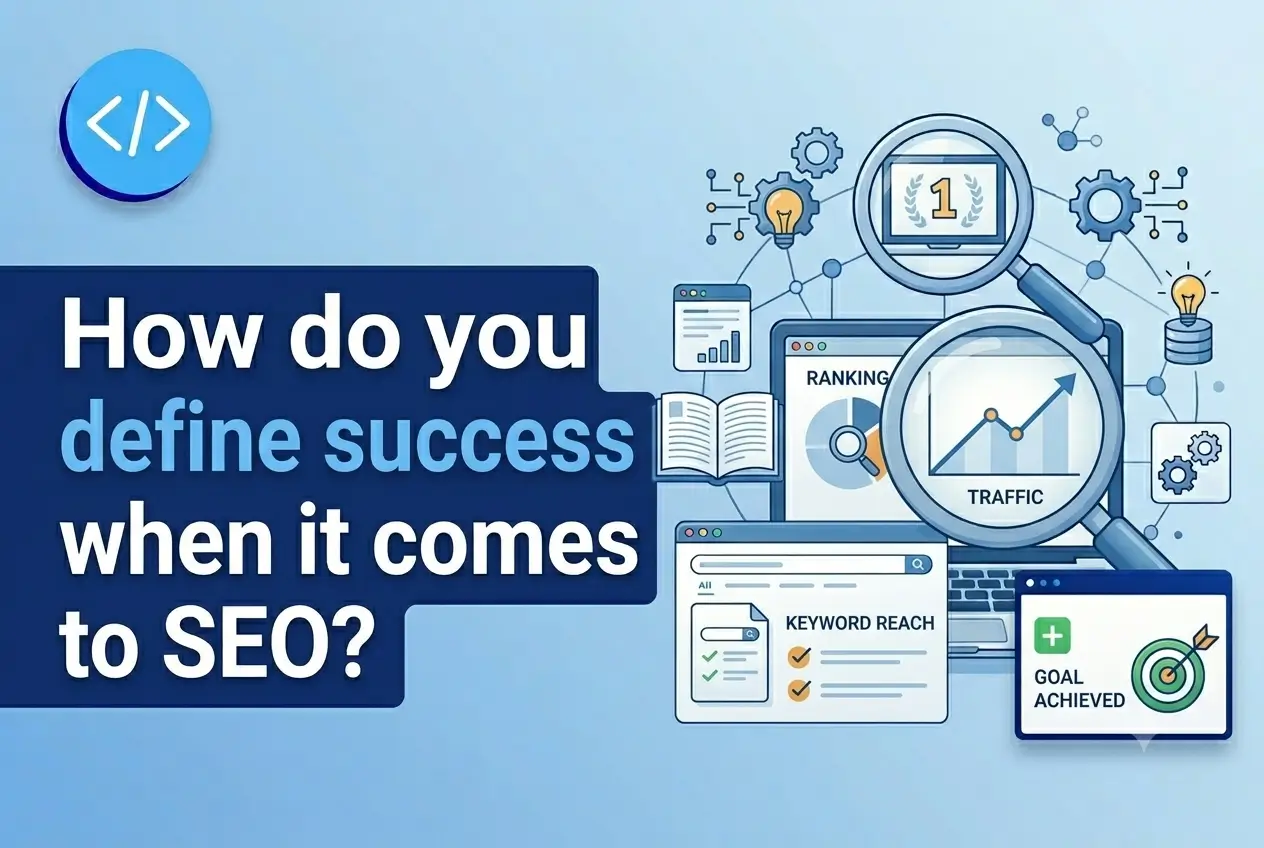
How do you define success when it comes to SEO?
SEO success is defined by whether organic search helps you reach your business goals. That usually means stronger search visibility, qualified organic traffic, higher click-through rates, more conversions from SEO, healthy technical performance, and measurable return on investment.
Why SEO Success Is More Than Rankings
Keyword rankings are useful, but they are not the whole story. A ranking tells you where a page appears for a specific query at a specific moment. It does not tell you whether that keyword attracts the right audience, whether users click your result, or whether those visitors become customers.
This is why focusing only on rankings can be misleading.
For example, imagine a local web design agency ranks number two for “free website templates.” That may bring traffic, but many searchers are probably looking for free resources, not a professional service. Now imagine the same agency ranks number six for “SEO web design services for small business” and receives fewer visits but more consultation requests. The second keyword may be more valuable.
SEO success metrics should reflect the role SEO plays in the business. For some sites, success means more organic leads. For ecommerce, it may mean more revenue from organic sessions. For publishers, it may mean growth in organic traffic, returning readers, and email subscriptions. For local SEO, it may mean Google Business Profile calls, website visits, direction requests, and map visibility.
Google Search Console’s Performance report measures clicks, impressions, click-through rate, and average position in Google Search results, which makes it one of the most practical starting points for SEO reporting. But those metrics become more meaningful when you connect them to business actions.
A healthy SEO strategy should answer three questions:
- Are more of the right people finding us?
- Are they engaging with useful pages?
- Are they taking valuable actions?
If the answer is yes, SEO is moving in the right direction.
How to Define SEO Success Step by Step
A clear SEO measurement process starts before you look at dashboards. You need to define what success means for your website, audience, and business model.
Step 1: Start With the Business Goal
Ask what SEO is supposed to support.
Common SEO goals include:
- More qualified leads
- More ecommerce sales
- More local calls or visits
- More demo bookings
- More newsletter subscribers
- Better brand visibility
- More organic traffic to educational content
- Lower dependency on paid ads
- Stronger topical authority
A small law firm, SaaS company, local restaurant, ecommerce store, and blog should not use the exact same SEO success definition.
Step 2: Choose the Right SEO KPIs
Once the goal is clear, choose KPIs that match it.
If the goal is visibility, track impressions, keyword rankings, indexed pages, and share of voice.
If the goal is traffic, track organic clicks, users, sessions, landing pages, and traffic quality.
If the goal is lead generation, track form submissions, calls, consultation bookings, quote requests, and CRM-qualified leads.
If the goal is revenue, track organic revenue, assisted conversions, average order value, and customer acquisition cost.
Step 3: Separate Leading and Lagging Indicators
Leading indicators show early progress. Lagging indicators show final results.
Leading SEO indicators include:
- More impressions
- Better index coverage
- Improved keyword positions
- More pages ranking
- Better Core Web Vitals
- More internal links
- New content published
Lagging SEO indicators include:
- More organic leads
- More sales
- More revenue
- Lower acquisition cost
- Higher lifetime value from organic customers
Both matter. Early indicators help you see movement before conversions arrive.
Step 4: Build a Baseline
Before judging success, record your starting point.
Track current organic traffic, conversions, keyword rankings, indexed pages, technical issues, and top landing pages. Without a baseline, you cannot tell whether performance is improving.
Use Google Search Console, Google Analytics 4, Ahrefs, Semrush, Moz, Screaming Frog, and Google PageSpeed Insights to build the baseline.
Step 5: Measure Over the Right Timeframe
SEO usually needs time. Some technical fixes can show results quickly, but content, authority, and ranking growth often take months.
A practical reporting rhythm is:
- Weekly checks for technical issues and sudden changes
- Monthly reporting for traffic, rankings, and conversion trends
- Quarterly strategy reviews for content, ROI, and business impact
Do not panic over one bad week. Look for patterns.
SEO Success Metrics, Tools, and Reporting
Good SEO reporting should be simple enough to understand and detailed enough to guide action. The goal is not to fill a report with every number available. The goal is to show what changed, why it changed, and what to do next.
Important SEO success metrics include:
- Search impressions: How often your site appears in search results
- Organic clicks: How many people click from search
- Click-through rate: The percentage of impressions that become clicks
- Average position: A broad ranking indicator in Search Console
- Keyword rankings: Where important terms rank over time
- Organic users and sessions: Traffic from unpaid search
- Engaged sessions: Visits with meaningful interaction
- Conversions from SEO: Leads, sales, calls, signups, or bookings
- SEO ROI: Business value compared with SEO cost
- Indexed pages: Pages available in search
- Technical SEO health: Crawl errors, speed, mobile usability, redirects, broken links
- Content performance: Pages gaining or losing traffic
- Local SEO actions: Calls, direction requests, profile views, and local rankings
Useful tools include:
- Google Search Console for impressions, clicks, CTR, average position, indexing, and queries
- Google Analytics 4 for organic traffic behavior and key events
- Google Looker Studio for SEO dashboards
- Ahrefs, Semrush, and Moz for keyword tracking and competitor research
- Screaming Frog for technical SEO audits
- Google PageSpeed Insights for performance and page experience checks
- Google Business Profile for local SEO actions
- HubSpot or CRM tools for lead quality and sales attribution
Google Analytics Help explains that GA4 key events are actions important to business success, and they can be used to evaluate marketing performance across channels. For SEO, that means you should mark meaningful actions like form submissions, purchases, calls, bookings, or signups as key events where possible.
A useful benchmark: do not judge SEO only by total traffic. A smaller amount of high-intent organic traffic can be more valuable than a large amount of low-intent traffic. For example, 500 organic visits that generate 20 qualified leads may be stronger than 5,000 visits that generate none.
For more practical planning, explore the SEO strategy resources on With Alvi.
Common Mistakes When Measuring SEO Success
One common mistake is treating rankings as the final goal. Rankings matter, but they are a means to visibility, traffic, and business outcomes. A keyword position is useful only if the keyword is relevant and drives meaningful action.
Another mistake is reporting traffic without context. Organic traffic growth is positive only if it brings the right audience. If traffic grows because of unrelated informational keywords, the business may not benefit.
A third mistake is ignoring conversions. If your website does not track form submissions, calls, purchases, or bookings, you are missing the clearest signal of SEO business impact.
Some businesses also expect SEO results too quickly. SEO is cumulative. Technical improvements, content growth, internal linking, and authority building often produce better results over time.
Another issue is measuring the wrong page types together. Blog posts, service pages, product pages, and local pages have different jobs. A blog post may drive awareness, while a service page should drive leads. Judge each page by its purpose.
Local SEO success is also often underreported. A local business should measure Google Business Profile actions, calls, map visibility, reviews, direction requests, and local landing page conversions, not just website traffic.
Finally, many reports are too complicated. If a business owner cannot understand the report, it will not guide decisions. Strong SEO reporting should highlight wins, risks, actions, and next steps.
The SCORE SEO Success Framework
The SCORE SEO Success Framework helps define SEO success in a way that connects search performance to business growth.
SCORE stands for:
- S: Search visibility
- C: Click quality
- O: Organic conversions
- R: Revenue or return
- E: Experience and technical health
S: Search Visibility
Search visibility measures whether your site is becoming easier to find. Track impressions, keyword rankings, indexed pages, and visibility for important topic clusters.
If impressions are growing for relevant queries, your SEO foundation may be improving even before traffic rises sharply.
C: Click Quality
Clicks matter, but quality matters more. Review click-through rate, landing page relevance, engagement, and whether visitors match your target audience.
A high CTR means your title and meta description may be doing their job. A low CTR with high impressions may mean your snippet needs improvement.
O: Organic Conversions
Conversions from SEO show whether organic visitors are taking meaningful action. This may include calls, form fills, purchases, subscriptions, quote requests, or bookings.
Set up GA4 key events and connect your CRM where possible.
R: Revenue or Return
SEO ROI connects performance to money. It may include revenue, lead value, customer lifetime value, or reduced paid advertising dependency.
Not every SEO campaign can measure revenue perfectly, but every campaign should define value.
E: Experience and Technical Health
Technical SEO health affects how search engines and users experience your site. Track crawl errors, broken links, page speed, mobile performance, indexation, redirects, and Core Web Vitals.
Use this formula:
SEO Success = Visibility Growth + Qualified Traffic + Conversions + Technical Health + Business ROI
This formula keeps SEO grounded. It prevents you from celebrating rankings that do not matter or traffic that does not convert.
If you want help auditing SEO performance and building a measurable growth plan, review With Alvi’s SEO and digital services.
Conclusion
So, how do you define success when it comes to SEO? You define it by connecting organic search performance to meaningful goals. Rankings and traffic matter, but they are not enough by themselves. Real SEO success means the right people find your website, click through, engage with useful content, and take actions that support your business.
Start with your business goal. Choose the right SEO KPIs. Build a baseline. Track visibility, qualified traffic, conversions, technical health, and ROI. Then review performance over time instead of reacting to every small fluctuation.
The most useful SEO reports do not just say what happened. They explain what changed, why it matters, and what should happen next. That is how SEO becomes a growth strategy instead of a guessing game.
Your next step: open Google Search Console and GA4, choose three business-focused SEO KPIs, and build your first simple monthly success dashboard.
FAQs
What is the best way to measure SEO success?
The best way to measure SEO success is to connect organic search metrics to business goals. Track visibility, clicks, qualified traffic, conversions, technical health, and ROI. Rankings matter, but they should be measured alongside leads, sales, calls, or other meaningful outcomes.
Are keyword rankings still important for SEO?
Yes, keyword rankings are still useful, but they should not be the only success metric. A ranking is valuable when the keyword matches search intent, attracts the right audience, and supports conversions or brand visibility.
How long does it take to see SEO success?
SEO timelines vary by competition, website quality, content depth, and authority. Some technical fixes may help quickly, but meaningful organic growth often takes several months. Measure early indicators first, then review traffic and conversions over time.
What SEO KPIs should small businesses track?
Small businesses should track organic clicks, impressions, CTR, local rankings, Google Business Profile actions, calls, form submissions, service page visits, and qualified leads. The best KPIs depend on whether the business wants calls, bookings, sales, or local visibility.
How do you calculate SEO ROI?
SEO ROI compares the value generated from organic search with the cost of SEO work. A simple version is: organic revenue or lead value minus SEO cost, divided by SEO cost. For lead-based businesses, assign an estimated value to qualified leads.
Why is my SEO traffic growing but leads are not?
Traffic can grow without leads if keywords are too informational, pages lack clear CTAs, content attracts the wrong audience, or conversion tracking is missing. Review landing pages, search intent, internal links, offers, forms, and GA4 key events to find the gap.